
For most people, escalators are a simple convenience — a routine part of daily travel through stations, airports and shopping centres.
For many guide dog users, they can become a significant barrier to safe and independent travel.
Across the UK and Europe, transport providers and public venues often operate policies requiring dogs to be carried on escalators for safety reasons. The concern is understandable. Escalators can present genuine risks to dogs, with moving steps and comb plates capable of causing serious injury if paws, fur or harnesses become trapped.
But while the safety rationale may be clear, the reality for many visually impaired passengers is far more complicated.
Guide dogs are not small pets. Many are large Labradors, Golden Retrievers or German Shepherds weighing 30 kilograms or more. Carrying a guide dog on a moving escalator is not simply inconvenient — for many people, it is physically impossible.
This creates a difficult and often overlooked accessibility challenge.
When Safety Policies Become Accessibility Barriers
Most transport providers advise passengers travelling with dogs to use lifts or step-free routes wherever possible. However, in practice, these alternatives are not always available.
Lifts may be:
• out of service
• difficult to locate
• overcrowded
• poorly signposted
• or positioned far from the most direct route through a station
For a visually impaired passenger navigating a busy and unfamiliar environment, this can quickly become stressful and disorientating.
In some cases, guide dog users may be forced to:
• ask strangers for assistance
• rely on station staff
• take lengthy detours
• or avoid certain journeys altogether
The situation becomes even more difficult when escalators are the only realistic route available.
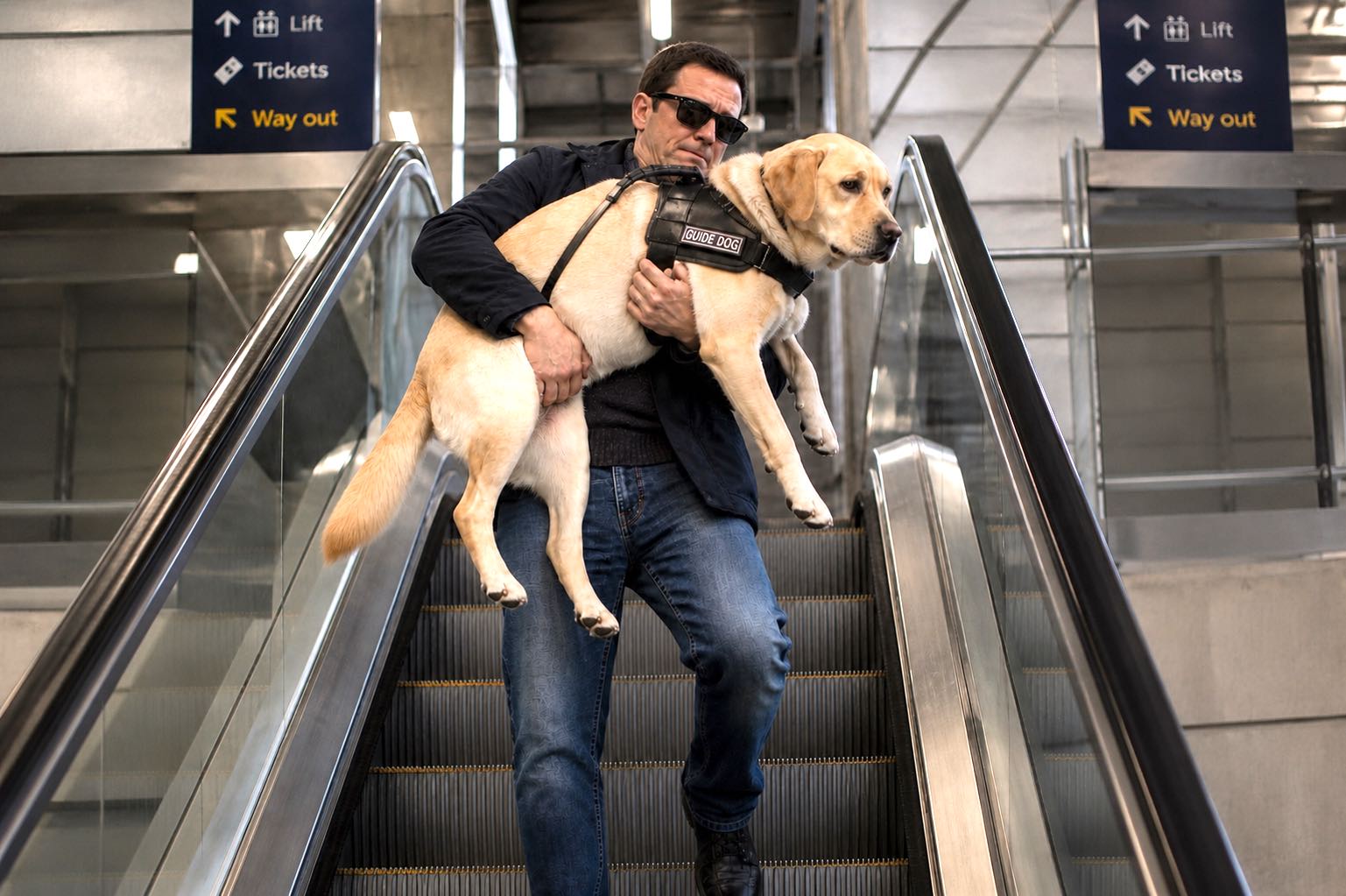
The image accompanying this article highlights the reality of that challenge. A visually impaired passenger is forced to carry a large guide dog on an escalator — a physically demanding and potentially unsafe situation that undermines the very independence guide dogs are trained to provide.
No one should have to carry a guide dog in order to travel independently.
The Challenge of Escalator Training
Some assistance dogs receive specialist training to use escalators safely. However, this training is highly specialised and not universally provided.
Even where dogs are trained, escalators can still present difficulties:
• busy stations
• crowded environments
• steep escalators
• sudden noise
• and fast-moving pedestrian traffic
can all increase stress and risk for both handler and dog.
Policies and staff understanding also vary significantly between transport operators and public venues. This inconsistency can lead to confusion, delays and uncertainty for passengers simply trying to complete everyday journeys safely.
Accessibility Must Go Beyond Minimum Compliance
At the European Guide Dog Federation, we believe accessibility should not depend on physical strength, local knowledge, or the availability of assistance from strangers.
True accessibility means creating transport systems and public spaces that are:
• safe
• reliable
• understandable
• and genuinely inclusive
That includes:
• reliable lift access
• better signage for step-free routes
• consistent policies
• improved staff awareness
• and infrastructure designed with disabled people in mind from the outset
Safety policies are important. But safety and accessibility must work together — not in conflict.
Guide dogs are trained to support independence and mobility.
Public infrastructure should support that independence too.
Supporting Real Inclusion
Too often, accessibility discussions focus only on whether disabled people are technically allowed to access a service.
Real inclusion goes further than that.
It asks whether people can use that service:
• safely
• confidently
• independently
• and with dignity
For guide dog users, that difference matters every single day.
At EGDF, we continue to work with transport providers, policymakers and accessibility organisations across Europe to help ensure public spaces are designed for everyone — not just the majority.
Because accessibility should never depend on being able to carry your guide dog.
Support More Accessible Travel for Guide Dog Users
At the European Guide Dog Federation, we work to improve accessibility, influence policy, raise awareness and support the rights of guide dog users across Europe.
But real change requires continued advocacy, education and collaboration with transport providers, businesses and public authorities.
You can help support this work by sharing this article, raising awareness of accessibility barriers, challenging poor accessibility design, and supporting organisations working to improve inclusion for visually impaired people.
Help us build a Europe where guide dog users can travel safely, confidently and independently.
👉 Support EGDF’s work: www.egdfed.org