
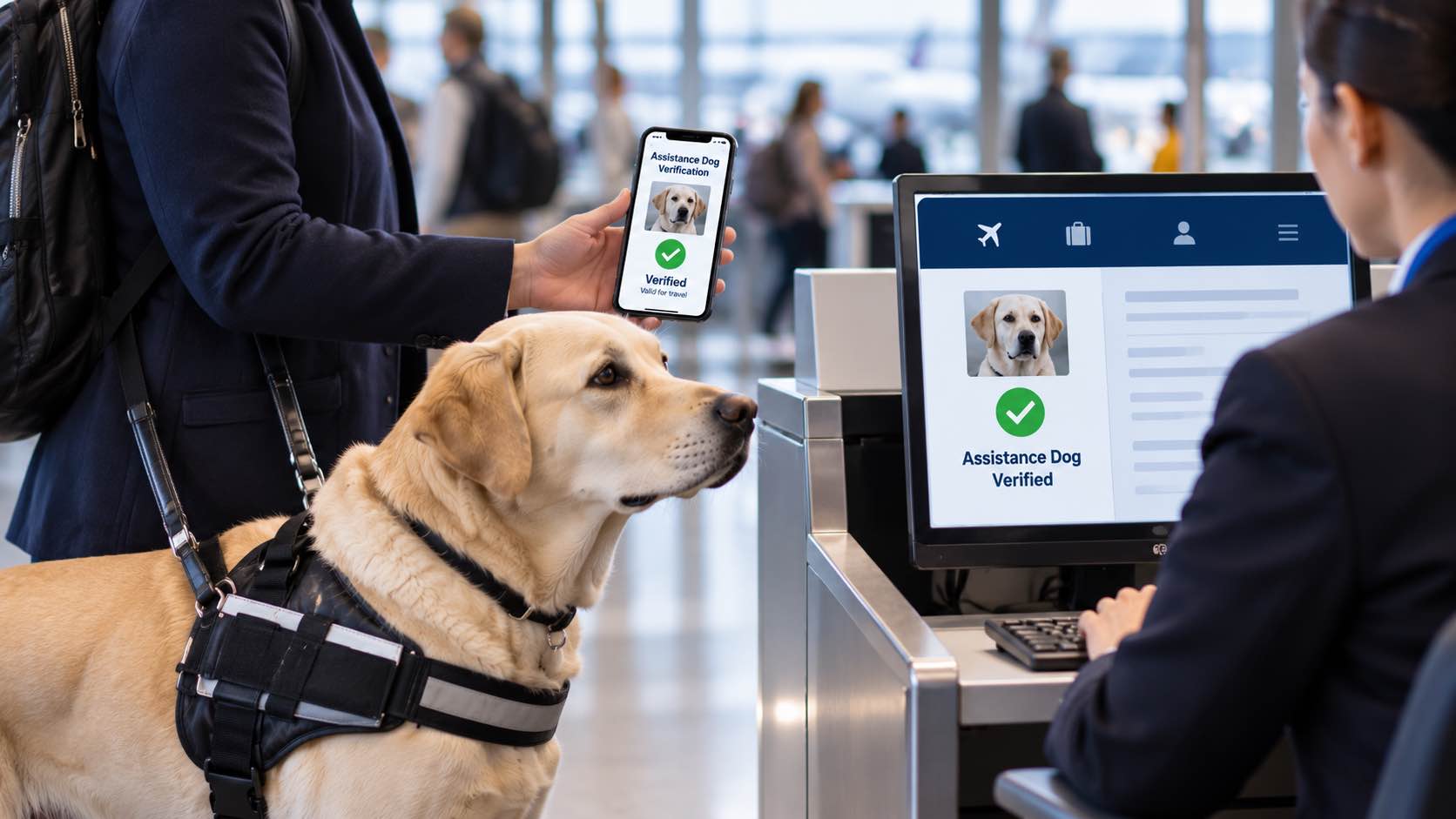
A recent dispute in the UK has highlighted a wider challenge facing assistance dog users and service providers: how can the status of an assistance dog partnership be established fairly and reliably?
In the UK, there is no single official registration or certification process for assistance dogs, and there is no legal requirement for them to wear identifying equipment.
That is important. Recognition should not depend simply on whether a dog was trained by a particular organisation. Assistance dogs can follow different legitimate training routes, including owner-training and training by smaller or independent organisations.
But when the status of an assistance dog is questioned, the absence of a universally recognised system can leave both disabled people and service providers in a difficult position.
Different routes, the same expectations
An assistance dog partnership should not be dismissed simply because the dog was trained by its disabled handler rather than by a large or internationally accredited organisation.
At the same time, service providers need confidence that a dog presented as an assistance dog has been appropriately trained to provide disability-related assistance and to behave appropriately in public.
The challenge is finding a fair and proportionate way of providing that confidence without creating unnecessary barriers for disabled people.
The challenge for businesses
Consider the position of a hotel, restaurant or transport provider faced with an assistance dog partnership they have not encountered before.
They want to respect the rights of their disabled customer and avoid refusing a legitimate assistance dog. But what reliable information is available if questions arise?
Requiring an identification card from a particular organisation risks excluding legitimate partnerships that have followed another training route.
Leaving individual employees to make their own judgement is hardly satisfactory either.
Independent assessment has an important role
One approach already exists in the UK.
The Assistance Dog Assessment Association (ADAA) provides independent assessments for assistance dog partnerships, including owner-trained and privately trained dogs.
Organisations such as ADAA can play an important role in a more inclusive approach to assistance dog recognition.
Where a partnership has not come through an established accredited training organisation, independent assessment can provide evidence that the dog and handler have demonstrated appropriate standards without making organisational affiliation the test of legitimacy.
This matters particularly for owner-trained dogs and dogs trained through smaller or independent organisations.
Different training routes need not mean different expectations of quality.
EGDF believes credible independent assessment should form part of the wider conversation about assistance dog recognition. It can provide a route for legitimate partnerships to demonstrate that they meet appropriate criteria while avoiding a system in which recognition is restricted to dogs trained by a particular group of organisations.
Assessment, certification and verification are different
These terms can easily become confused, but the distinction matters.
Assessment considers whether an assistance dog partnership meets defined criteria. Certification or accreditation provides formal recognition against particular requirements.
Verification has a different purpose.
Verification can establish whether information presented about an assistance dog partnership is supported by evidence from recognised and trusted sources.
An organisation such as ADAA can assess a partnership against defined criteria. An independent verification service can establish whether the evidence presented comes from recognised and trusted sources.
Neither needs to replace the other.
EGDF does not accredit or certify individual assistance dog partnerships. Nor would verification itself determine whether an assistance dog should be accepted by a particular business, airline, transport operator or other service provider.
That decision remains with the service provider.
What independent verification can do is provide trusted information to support informed and consistent decision-making.
Developing a European approach
This question extends well beyond the UK.
Across Europe, assistance dog users travel between countries with different systems, different approaches to recognition and different expectations about what evidence should be provided.
For EGDF, an important principle is that quality should not be confused with organisational affiliation.
This is why EGDF is working on an independent verification service for assistance dog partnerships.
The objective is not to create another certification scheme, accredit individual partnerships or restrict recognition to dogs associated with particular organisations.
Instead, EGDF is exploring how evidence from recognised and trusted sources can be independently verified, giving disabled people and service providers greater confidence in the information on which decisions are based.
Independent assessment organisations can be an important part of that landscape.
Together, appropriate standards, credible independent assessment and trusted verification could provide a more inclusive and reliable approach to assistance dog recognition.
Help us build a more accessible Europe
EGDF works to improve access, rights and independence for guide and assistance dog users across Europe. Developing practical solutions to the barriers they face is an important part of that work.
By sponsoring EGDF, you can help us challenge barriers, influence change and develop practical solutions that make a difference.https://www.egdfed.org/donate/