
Overview
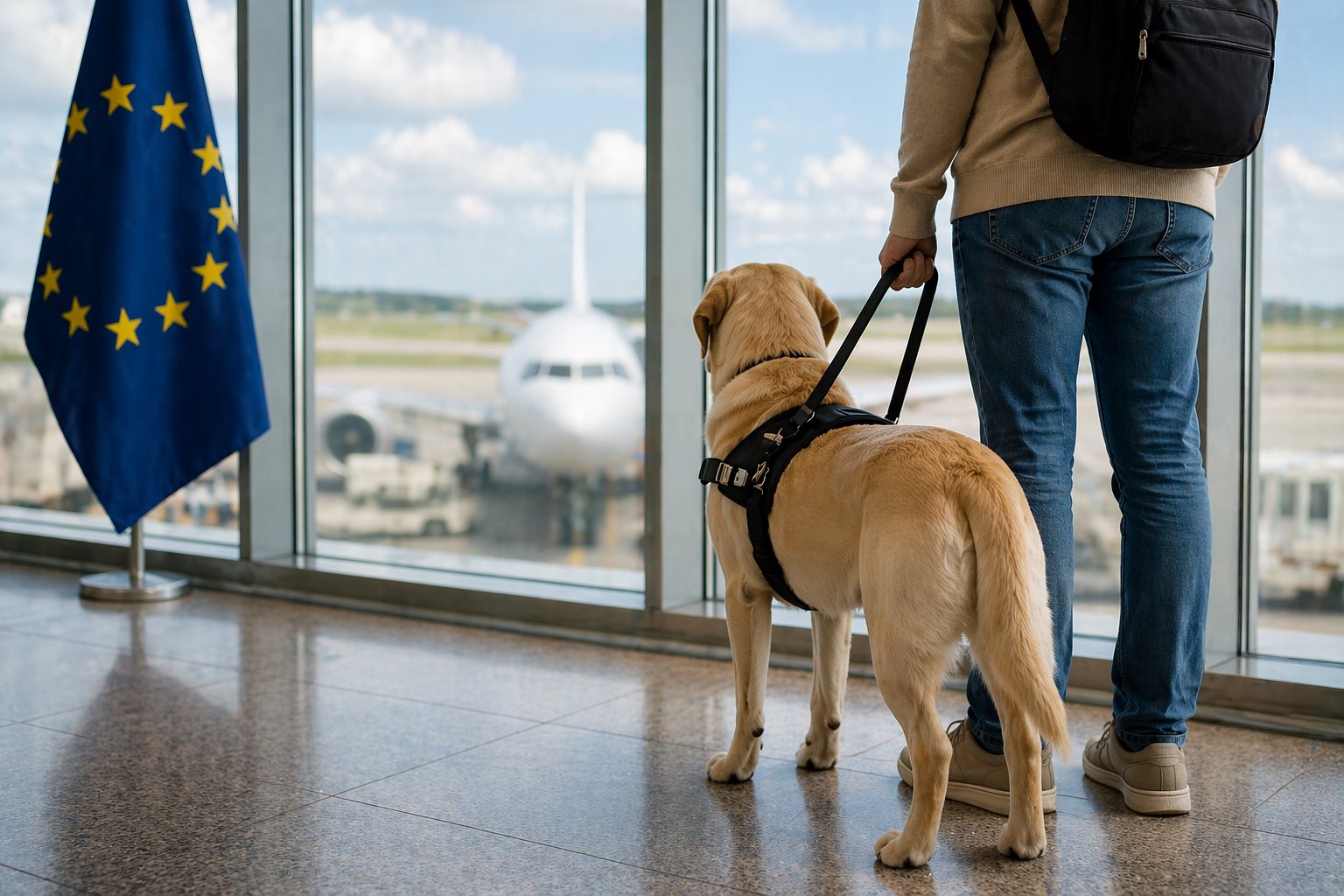
Travel between Great Britain and the European Union for guide and assistance dog users continues to present significant challenges. While legal protections for assistance dogs exist across Europe, the practical reality of cross-border travel remains complex, inconsistent, and increasingly restrictive.
Since the UK’s departure from the European Union, Great Britain has been treated as a third country for pet travel purposes. This change has had a direct impact on guide dog users, requiring compliance with additional health certification processes and introducing administrative burdens that were previously unnecessary.
In recent developments, further clarification has confirmed that EU pet passports held by Great Britain residents are no longer valid for travel to the European Union. This change removes a practical workaround that some guide dog users had relied upon, creating additional barriers at a time when a more consistent and accessible system is needed.
Post-Brexit Travel Requirements
Following Brexit, the automatic recognition of EU pet passports issued in the UK ceased. As a result, guide dog users travelling from Great Britain to the EU are required to obtain an Animal Health Certificate (AHC) for each journey.
This requirement has introduced several challenges:
- Time-limited validity: AHCs are valid for a single entry into the EU and limited onward travel
- Administrative burden: Each journey requires veterinary certification
- Cost implications: Repeated certification increases financial pressure, particularly for frequent travellers
- Planning constraints: Travel must be carefully scheduled around certificate validity
For guide dog users who rely on consistent and predictable travel arrangements, these requirements have reduced flexibility and increased uncertainty.
Emergence of a Practical Workaround
In response to these challenges, some UK-based guide dog users sought alternative approaches to facilitate repeat travel between Great Britain and EU Member States.
One such approach involved obtaining EU-issued pet passports through arrangements in EU countries. While not a formally structured or widely accessible solution, this provided a practical workaround for some travellers.
This route enabled:
- Reduced reliance on repeated Animal Health Certificates
- Lower administrative complexity
- Greater ease for frequent or short-notice travel
- Improved confidence when planning cross-border journeys
For those able to access it, this workaround represented one of the few practical mechanisms available to manage ongoing travel between the UK and EU.
Recent Clarification and Removal of the Workaround
Guidance issued by the UK Animal and Plant Health Agency (APHA) to veterinarians in April 2026 has clarified that:
👉 EU pet passports held by Great Britain residents are no longer valid for travel to the EU, including those issued prior to this date.
This clarification is being implemented in practice and removes the ability for UK residents to rely on EU-issued pet passports as a travel document.
As a result:
👉 A practical workaround that had enabled some guide dog users to travel more easily has now been effectively removed.
This represents a further tightening of an already complex system.
Immediate Impact on Guide Dog Users
The removal of EU pet passport validity has an immediate and tangible impact on guide dog users travelling between Great Britain and the European Union.
Individuals who had been able to use EU pet passports must now revert fully to the third-country process, relying on Animal Health Certificates for each journey.
This creates several direct consequences:
- Increased financial burden
Repeated veterinary appointments and certification fees significantly increase travel costs - Administrative complexity
Each journey requires planning, documentation, and compliance with time-sensitive requirements - Reduced flexibility
Short-notice travel becomes difficult or impractical - Uncertainty and inconsistency
Variation in interpretation across borders and transport providers adds further unpredictability
For disabled travellers, these challenges are not simply inconvenient — they directly affect independence, mobility, and participation in professional and social activities.
In some cases, the complexity and cost involved may discourage travel altogether.
Inconsistency Across the Travel System
The removal of this workaround highlights a broader issue within the European travel framework for assistance dog users.
While legislation provides for the rights of assistance dog users, the practical implementation of these rights in a cross-border context remains inconsistent.
Guide dog users continue to encounter variation in:
- Documentation requirements and enforcement
- Border control procedures
- Airline policies and acceptance criteria
- Interpretation of rules at national level
This lack of consistency undermines confidence and creates a fragmented travel experience.
Positive examples of good practice at individual airports or airlines do exist. However, these are not sufficient to offset the overall lack of a coordinated and predictable system.
Policy Context and Future Developments
There are ongoing discussions between the UK and the European Union regarding a potential Sanitary and Phytosanitary (SPS) agreement, which could simplify pet travel arrangements.
Such an agreement could:
- Reduce or remove the need for repeated certification
- Restore greater consistency between UK and EU travel requirements
- Provide a more stable framework for long-term travel
However, at present:
- No agreement has been finalised
- Timelines remain uncertain
- Existing requirements continue to apply
In the absence of a confirmed solution, guide dog users are experiencing the impact of current restrictions without clarity on future improvements.
The Need for a Practical and Coordinated Approach
The current situation highlights the gap between regulatory frameworks and the practical needs of guide dog users.
There is a clear need for:
- A consistent cross-border travel framework
- Recognition of real-world travel patterns, including frequent and short-notice journeys
- Alignment between UK and EU authorities
- Clear guidance for implementation across all points in the travel chain
Without a coordinated approach, barriers will persist and may continue to increase.
EGDF Position
The European Guide Dog Federation recognises that the current situation reflects both structural changes following Brexit and recent clarification that removes a practical workaround used by some guide dog users.
👉 This is not simply a regulatory change — it has immediate and significant consequences for independence and mobility.
EGDF is actively engaging with stakeholders, including national authorities and European institutions, to highlight the impact of these developments and to advocate for a more practical and consistent approach to cross-border travel.
EGDF believes that:
- Travel systems must be workable in practice, not only compliant in principle
- Barriers to cross-border mobility should be reduced, not increased
- The specific needs of guide and assistance dog users must be explicitly considered in policy development
👉 EGDF will continue to actively lobby for changes that remove unnecessary barriers and deliver a clear, consistent system for guide dog users travelling across Europe.
EGDF also welcomes ongoing discussions between the UK and EU and stands ready to contribute expertise to support the development of a sustainable and practical solution.
Conclusion & Next Steps
Travel between Great Britain and the European Union for guide dog users remains complex and increasingly restrictive.
The recent confirmation that EU pet passports held by Great Britain residents are no longer valid removes a practical option that had helped some users manage cross-border travel.
As a result, guide dog users face increased reliance on more burdensome processes, with immediate effects on cost, flexibility, and confidence.
👉 This is not simply a regulatory issue — it is a barrier to independence and mobility.
The European Guide Dog Federation is actively lobbying for a clear, consistent and practical travel system across Europe that reflects the needs of guide dog users in practice.
Support This Work
Your support helps us continue to advocate for change and challenge decisions that create unnecessary barriers.