
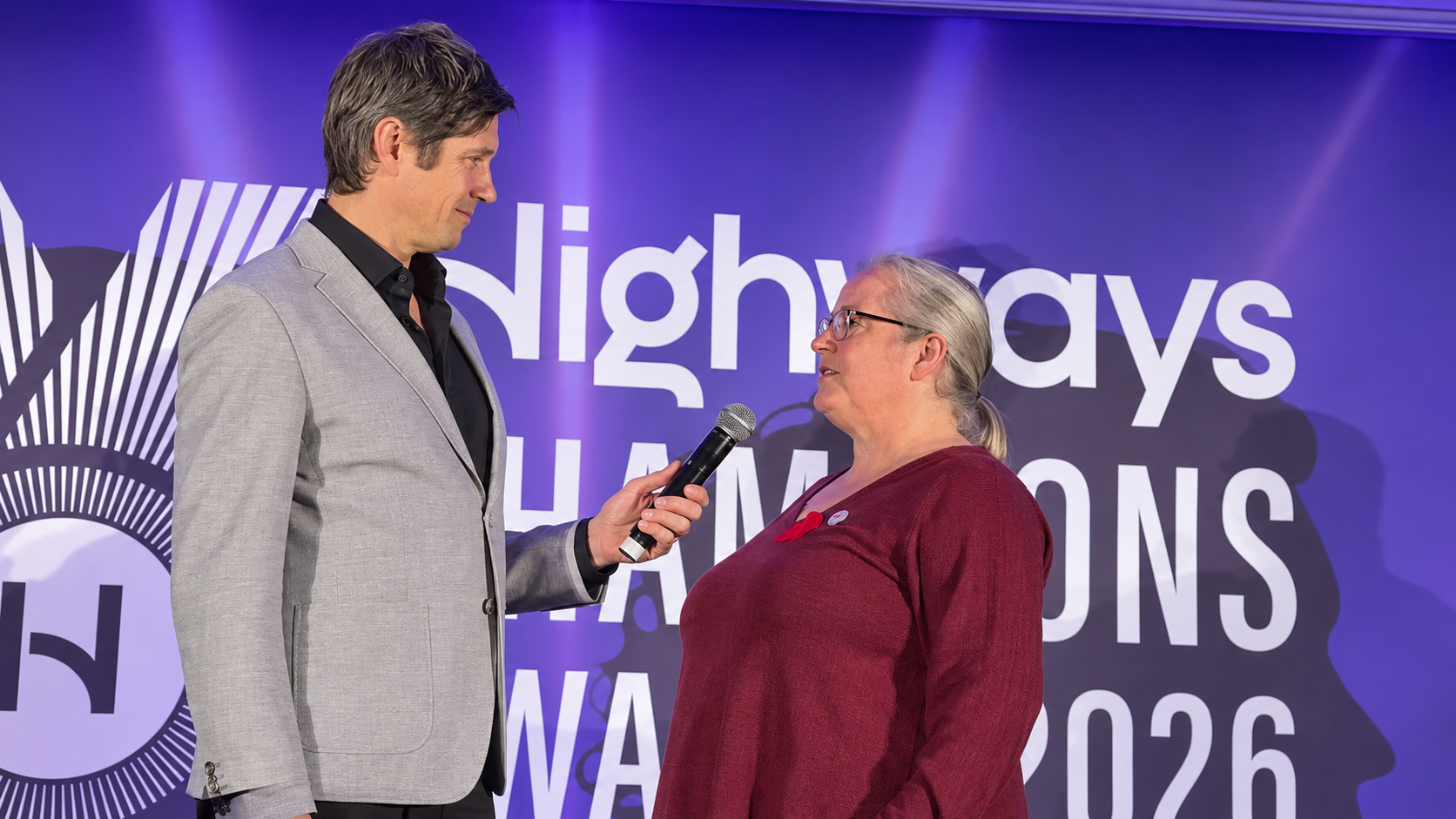
Vernon Kay presented Sarah Gayton with a Highways Champions Medal at the 2026 Highways Champions Awards. Sarah was recognised for campaigning for safer streets for blind and partially sighted people, including her work scrutinising Transport for London’s safety review of floating bus stops.
Sarah was nominated by the immediate past president of the National Federation of the Blind of the UK (NFBUK). The European Guide Dog Federation congratulates her on this recognition.
Why floating bus stops matter
At one common type of floating bus stop, a cycle lane runs between the pavement and a boarding island. Passengers have to cross the cycle lane to reach the stop or to return to the pavement after getting off the bus.
For blind and partially sighted passengers, finding the crossing is one part of the journey. Judging whether a cyclist is approaching and when it’s safe to cross can be another. That short stretch of cycle lane can determine whether someone feels able to make the whole journey independently.
Sarah went back to the data
When Transport for London (TfL) published its safety review, Sarah worked through the underlying figures herself. According to Highways, she identified significant inconsistencies and raised her findings with the National Audit Office, MPs and the media. TfL subsequently withdrew the original report and committed to reanalysing the figures.
Highways Champions Awards coverage
What happens when passengers stop using the bus stop?
In its revised review, published on 13 November, TfL maintained that the risk of pedestrian injury at bus stop bypasses was very low. Sarah told The Standard that incidents were going unreported and warned that some disabled Londoners, particularly people with sight or mobility impairments, were avoiding these stops altogether.
TfL compared bus boardings before and after bypasses were installed between 2019 and 2022. It found a slightly greater drop in boardings by older and disabled passengers at stops where bypasses had been installed. The Standard reported a difference of up to 3%. The figures leave open why those passengers boarded less often.
If someone changes their route, pays for a taxi or gives up a journey because they feel unable to cross the cycle lane safely, their experience will be missing from the collision figures. It still matters when judging whether the stop is accessible.
The Standard’s coverage of the revised TfL review
Involve passengers while designs can still change
Councils and transport authorities should involve blind and partially sighted passengers, including guide dog users, while there is still time to change the plans. Walking the route with passengers can show whether they can find the crossing, judge when it’s safe to cross and reach the boarding point independently.
Help guide dog users travel independently
EGDF works to influence laws, policies and attitudes so guide dog users can travel safely and independently across Europe. Your donation helps us bring guide dog users’ experiences to the people who make decisions about streets, transport and public spaces.
If you’re able to, please consider making a donation to support our work.