
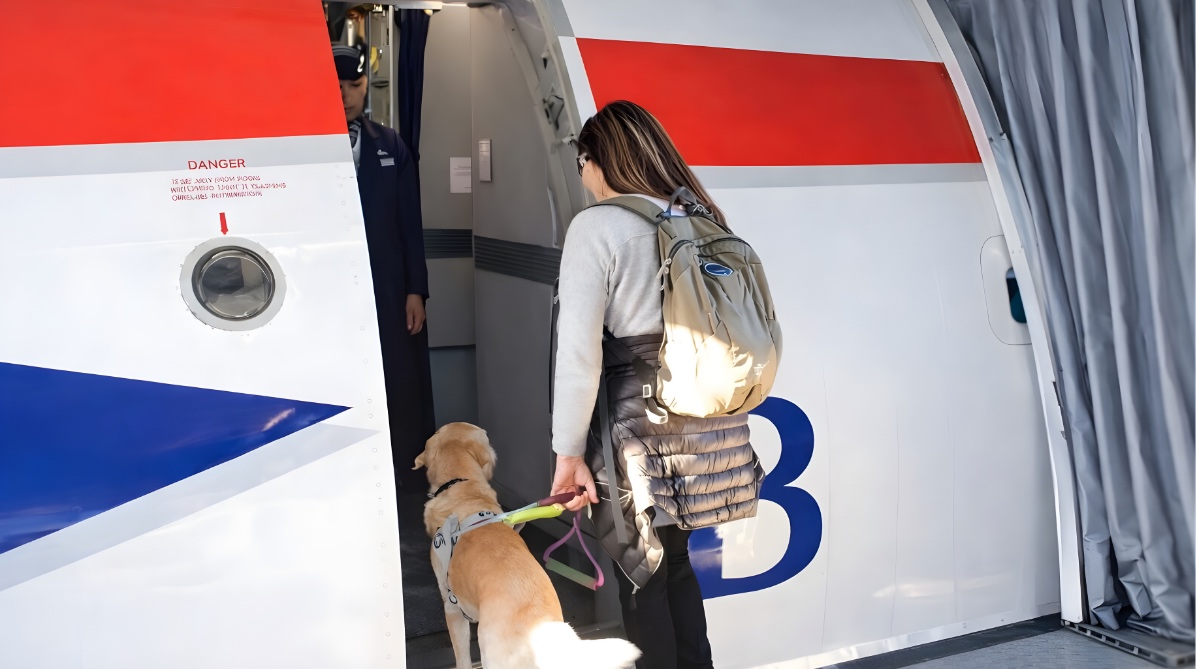
A blind passenger travelling with her guide dog through Heathrow Terminal 3 experienced repeated difficulties at airport security, including confusion over documentation, poor communication and inappropriate handling of her guide dog partnership.
After the issue was raised by the European Guide Dog Federation (EGDF), her most recent journey through the airport was significantly improved — highlighting the difference that awareness, communication and appropriate staff understanding can make.
This report outlines what happened, why it mattered, and what can be learned from the outcome.
Background
Inger Stokke is a blind and experienced international traveller who regularly flies between London and Oslo with her guide dog, Ripley. Ripley was trained by Lund Hundetjenester, a member organisation of the European Guide Dog Federation (EGDF).
Like many guide dog users, Inger relies on her dog not only for mobility, but also for orientation, confidence and independence while travelling.
Although she travels regularly and has not experienced comparable difficulties at other UK or international airports, several journeys through Heathrow Terminal 3 in late 2025 created repeated and unnecessary barriers.
Problems Experienced at Security Screening
Across multiple journeys through Heathrow Terminal 3, including on 30 September and 14 November, Inger encountered several recurring problems.
Boarding pass challenges
Inger’s valid and correctly issued boarding pass, clearly marked SVAN BLND, was repeatedly questioned as “incorrect”.
When she explained that she is blind and therefore unable to visually verify printed details in the same way as a sighted passenger, she was accused of being rude.
Confusion over documentation
Despite presenting the correct paperwork for Ripley — including IGDF certification and airline-approved documentation — Inger was repeatedly asked for further documents.
Staff were unable to explain clearly what additional paperwork was required.
On one occasion, Heathrow staff reviewed HARC approval documentation, which is relevant only to entry into the UK, and incorrectly stated that it was “out of date”, despite it being unrelated to her departure from the UK.
Inappropriate handling of the guide dog partnership
Ripley is fully trained to work safely and calmly in airport security settings. This includes being briefly unharnessed, remaining calmly in place, allowing Inger to pass independently through screening, and rejoining her on verbal command.
Despite this, Inger was separated from her guide dog during screening.
Most concerningly, a member of security staff reportedly stated that “these kinds of dogs are regularly used for smuggling.”
This comment was deeply upsetting and reflected a serious lack of understanding of guide dogs as essential mobility aids rather than pets.
Poor complaint handling
Following these incidents, Inger submitted a formal complaint to Heathrow.
However, the response focused largely on CCTV footage, stating that procedures had been followed correctly. This did not address a central part of the complaint: the verbal interactions, inappropriate comments and communication failures that had caused the greatest distress.
Inger was also advised that she could attend Heathrow to review CCTV footage herself — an impractical and unreasonable suggestion given her visual impairment and the absence of audio recordings.
Impact on Confidence and Independence
These repeated experiences had a significant impact on Inger’s confidence and sense of independence while travelling.
For blind passengers travelling with guide dogs, respectful communication, consistent procedures and an understanding of the guide dog partnership are essential. When these are lacking, the impact can go far beyond inconvenience.
Inger’s experience also highlighted how a lack of awareness can turn a routine journey into a stressful and avoidable barrier.
EGDF Engagement
EGDF became involved to help raise the issues constructively and support improvement.
The concerns were initially escalated through Heathrow’s complaints process, but after extensive correspondence there was little practical progress.
The matter was then raised with the Civil Aviation Authority (CAA) and the Heathrow Accessibility Action Group (HAAG).
While the CAA advised that it could not intervene directly without a specific escalation route being followed, there was clear concern about the seriousness of the issues raised.
EGDF’s approach throughout was focused on respectful communication, practical improvement, appropriate staff awareness, and ensuring that accessibility and security are treated as fully compatible.
A Positive Outcome
In April 2026, Inger travelled through Heathrow Terminal 3 again — and this time, the experience was markedly different.
At security, Inge explained that Ripley is trained to:
- be briefly unharnessed
- remain calmly in place
- allow her to pass independently through the scanner
- and rejoin her on verbal command
On this occasion, the supervising security officer listened, understood the training involved, and recognised that this was the most appropriate and effective way to manage the screening process.
The result was a calm, efficient and respectful experience that met both:
- security requirements
- and Inger’s need for independence and dignity
For Inger, this was a significant and welcome improvement.
Why This Matters
This experience shows that accessibility and security are not in conflict.
Blind passengers travelling with guide dogs do not need special treatment — they need appropriate understanding, respectful communication and consistent practice.
This case also demonstrates that:
- guide dog partnerships can be accommodated within security procedures
- staff confidence and awareness make a significant difference
- poor communication can create unnecessary barriers
- constructive advocacy can help drive positive change
Looking Forward
While continued consistency is essential, this outcome provides a strong example of how better understanding and practical adjustments can transform the travel experience for blind passengers travelling with guide dogs.
EGDF hopes this improved practice will continue, be embedded more consistently, and contribute to better awareness across airports and other transport settings.
Blind and partially sighted travellers should be able to move through airports with the same confidence, dignity and independence as anyone else.
Have you experienced barriers while travelling with a guide dog?
EGDF continues to work with partners and stakeholders to improve accessibility, understanding and equal access across Europe.
Support Our Work
If you would like to help us continue advocating for guide dog users across Europe, you can support EGDF here