
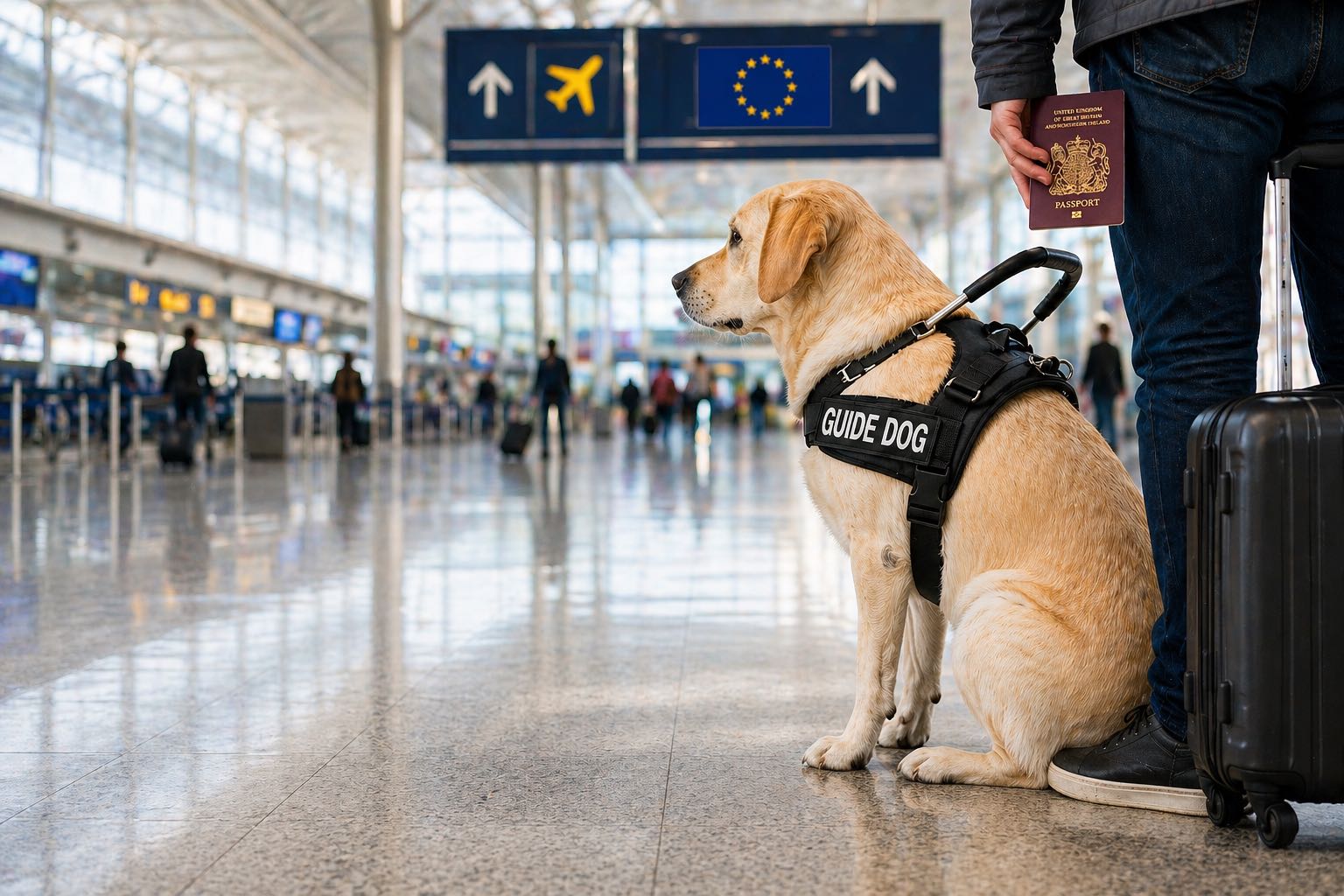
A growing challenge for cross-border mobility
Travelling with a guide dog between Great Britain and the European Union has become significantly more difficult in recent years — and recent clarification from authorities has now removed one of the few remaining workarounds.
Since the UK left the European Union, Great Britain has been treated as a “third country” for the purposes of pet travel. For guide and assistance dog users, this has meant that each trip to the EU requires an Animal Health Certificate (AHC).
While this system was designed for general pet travel, its impact on disabled people has been substantial.
The real impact on guide dog users
For many guide dog users, travel is not occasional — it is essential.
Whether for work, family, advocacy, or independence, the requirement to obtain a new AHC for every journey creates:
- Significant cost for each trip
- Administrative burden navigating veterinary processes
- Uncertainty around compliance and documentation
- Reduced freedom to travel spontaneously or regularly
What might be manageable for a holiday pet owner becomes a repeated barrier for someone relying on a guide dog every day.
A workaround removed
In the absence of a long-term solution, some UK-based assistance dog users had found ways to manage more regular travel.
One such approach was the use of EU-issued pet passports, obtained through arrangements in EU Member States. While not ideal, this provided a more practical way for frequent travellers to maintain mobility.
However, guidance issued by the UK Animal and Plant Health Agency (APHA) in April 2026 has now clarified that:
👉 EU pet passports held by Great Britain residents are no longer valid for travel to the EU — including those issued previously.
This clarification is now being implemented in practice, removing this option entirely.
Limited alternatives: Article 29 permits
Recent correspondence with EU officials has highlighted a potential alternative under Article 29 of Regulation (EU) 2026/131.
This provision allows for special permits to be issued by individual EU Member States.
While this may offer some support — particularly for those travelling regularly to the same country — it presents its own challenges:
- Applications must be made to each individual Member State
- There is no single EU-wide solution
- Processes and requirements may vary between countries
In practice, this means that a guide dog user travelling across multiple countries in Europe could face multiple applications and administrative processes.
The bigger picture: delays and uncertainty
Discussions between the European Union and the United Kingdom on a broader sanitary and phytosanitary (SPS) framework are ongoing.
There is hope that a future agreement could introduce more streamlined and proportionate arrangements for travel — including for assistance dogs.
However, at present:
- No timeline has been confirmed
- No interim solution has been introduced
- Barriers continue to increase in the short term
For guide dog users, this means the situation is not just complex — it is getting harder, not easier.
Why this matters
This is not simply an administrative issue.
For guide dog users, these rules directly affect:
- Freedom of movement
- Access to work and opportunities
- Participation in European life
Barriers to travel are barriers to independence.
EGDF’s position
The European Guide Dog Federation continues to engage with policymakers and stakeholders to highlight these challenges.
We have offered our expertise to support the development of practical, proportionate solutions that reflect the real needs of assistance dog users.
A system designed for pets should not unintentionally restrict the mobility of disabled people.
Looking ahead
While longer-term discussions continue, the immediate priority must be to:
👉 Reduce unnecessary barriers
👉 Provide clarity and consistency
👉 Recognise the unique role of assistance dogs
Until then, guide dog users travelling between Great Britain and the European Union continue to face avoidable and increasing challenges.
Have you experienced barriers while travelling with a guide dog?
EGDF continues to work with partners and stakeholders to improve accessibility, understanding and equal access across Europe.
Support Our Work
If you would like to help us continue advocating for guide dog users across Europe, you can support EGDF here