
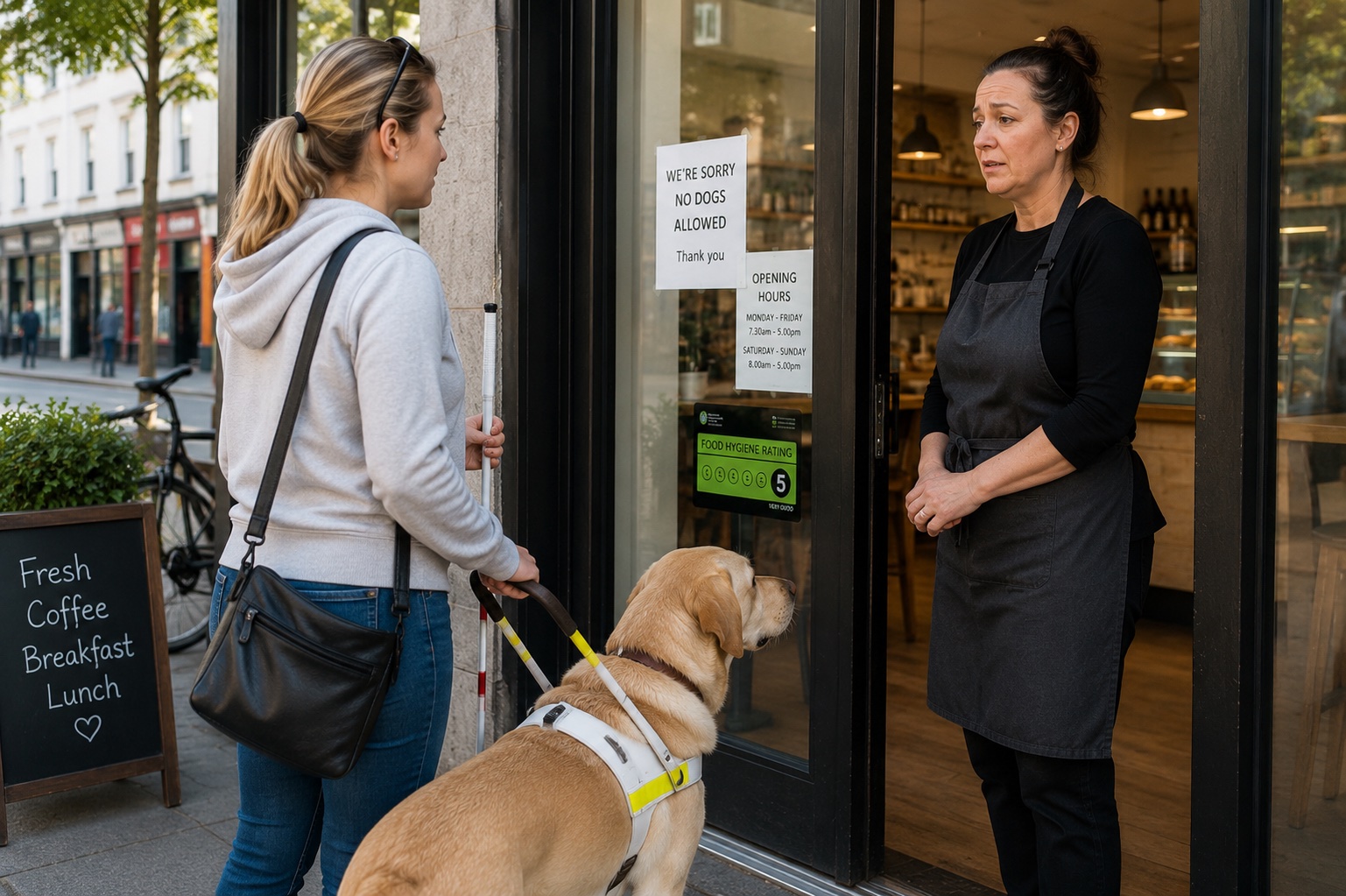
New UK guidance & an Australian discrimination case highlight an important principle: access should be considered from the perspective of the disabled person, not simply whether a dog is permitted.
When a guide or assistance dog user is refused access to a restaurant, hotel, public service or other facility, the conversation can quickly become focused on the dog.
Are dogs allowed? Is there a no-dogs policy? Does the dog meet particular requirements?
But perhaps we need to start with a different question:
Does the disabled person have equal access?
Two recent developments, on opposite sides of the world, provide an interesting opportunity to consider that question.
A new statutory Code in Great Britain
On 5 August 2026, the Equality and Human Rights Commission’s new statutory Code of Practice for Services, Public Functions and Associations came into force in England, Scotland and Wales.
The Code provides detailed guidance on the Equality Act 2010. It does not create new law or new legal obligations, but its statutory status is important: relevant parts of the Code must be considered by courts and tribunals in proceedings under the Act.
For guide and assistance dog users, some of the examples within the new Code are particularly significant.
The Code reinforces that the duty to make reasonable adjustments is anticipatory. In other words, service providers and those exercising public functions should think in advance about barriers disabled people may encounter. They should not simply wait until an individual experiences a problem and then decide how to respond.
One example makes the relevance to guide dog users particularly clear.
The Code explains that visually impaired people who use guide dogs will be prevented from using a service by a “no dogs” policy, while visually impaired people who use only white canes will not face that particular barrier.
Both are visually impaired. Both have rights to access. But the adjustment each may require is different.
That may sound obvious, but it illustrates something important.
Accessibility cannot always be achieved by treating everybody in exactly the same way.
The dog is not the issue
Existing EHRC guidance for businesses and service providers already makes clear that assistance dogs are not pets. They provide support or assistance to a disabled person and can be fundamental to that person’s independence and confidence.
The guidance also explains that a “no dogs” policy can disadvantage disabled people who use assistance dogs and that it will often be reasonable to change or waive such a policy.
Again, the important point is not really about making an exception for a dog.
It is about removing a barrier faced by a disabled person.
That distinction was expressed particularly powerfully in a recent Australian case.
An interesting parallel from Australia
In Klein v Sporting Shooters Association of Australia (Qld) Inc, the Full Federal Court of Australia considered the case of a disabled man who had been prevented from participating in activities because he was accompanied by his trained assistance dog.
The organisation argued that its concerns related to the presence of the dog rather than the man’s disability.
The Court rejected that approach.
In its summary of the judgment, the Human Rights Law Centre records the Court’s finding that:
“the presence of the assistance dog was inseparable from the disability.”
The Court found that separating the assistance dog from the disability was the wrong approach under Australia’s Disability Discrimination Act.
Australian discrimination law is, of course, different from the laws applying in the UK and across Europe. This judgment does not establish a legal precedent outside Australia.
But the principle behind those words deserves attention.
From “Is the dog allowed?” to “Can the person access?”
Too many access situations still begin with a rule about animals.
No dogs in the restaurant.
No animals in the hotel.
No pets in the vehicle.
No dogs in this area.
For most customers, those rules may create no difficulty whatsoever.
For somebody whose independence and mobility depend upon a guide or assistance dog, the effect can be entirely different.
The new EHRC Code explicitly recognises this distinction. It requires organisations to consider the different barriers faced by people with different disabilities – and even the different barriers faced by people with the same impairment who use different forms of support.
This moves the conversation in an important direction.
Instead of asking only whether an organisation’s general policy permits dogs, we should be asking whether that policy prevents a disabled person from accessing a service, facility or opportunity on an equal basis.
Anticipating access, rather than reacting to exclusion
There is another important message in the new Code.
Accessibility should be considered before somebody encounters a barrier.
The Code says organisations should proactively consider the barriers disabled people could face and take action to address them before an individual needs to use the service.
For guide and assistance dog users, that could mean ensuring policies already recognise assistance dogs, staff understand those policies and organisations have thought about how a disabled person accompanied by an assistance dog will access their service.
That is far better than leaving an individual guide or assistance dog user to explain, negotiate or challenge a decision at the point of access.
The Code also gives an example involving a police policy of not carrying civilian dogs in police vehicles. Where a disabled person relies on a guide or assistance dog, allowing the dog to travel with them is given as an example of an adjustment that is likely to be reasonable.
Again, the important question is not simply whether the organisation normally allows dogs.
It is what needs to happen to ensure the disabled person can access the service.
A wider European issue
Although the new EHRC Code applies only in England, Scotland and Wales, the underlying issue extends far beyond Great Britain.
Guide and assistance dog users continue to experience inconsistent approaches to access across Europe.
Similar questions arise when people travel internationally. Rules concerning animals, transport and cross-border movement can have a very different impact when the animal concerned is an assistance dog relied upon by a disabled person.
EGDF has recently highlighted some of these issues in relation to EU Pet Passports and the travel challenges facing guide dog users.
At EGDF, we believe this distinction matters.
Guide and assistance dogs should not be considered simply as animals seeking an exemption from a rule.
They should be considered in the context of the disabled person’s rights, independence, mobility and ability to participate fully in society.
The Australian judgment provides one particularly clear expression of that principle: the assistance dog and the disability cannot simply be separated when considering whether the person has been discriminated against.
The new EHRC Code approaches the issue through the duty to anticipate and remove the barriers experienced by disabled people.
Different legal systems. Different circumstances.
But both encourage us to look at access from the same starting point:
the person.
That is a principle that should increasingly inform the way businesses, public authorities, transport providers and policymakers across Europe approach guide and assistance dog access.
Because ultimately, assistance dog access is not simply about dogs.
It is about people, rights and equal participation.
EGDF’s View
EGDF believes that access involving a guide or assistance dog should always be considered first and foremost as an issue of disabled people’s rights and equal participation.
A guide or assistance dog is not simply an animal accompanying its user. For many disabled people, the partnership is fundamental to independence, mobility and participation in everyday life.
Businesses, public authorities, transport providers and policymakers should therefore design their policies around enabling equal access, rather than requiring individual users to repeatedly seek exceptions to rules that were never designed with them in mind.
The principle is simple:
Don’t start by asking whether the dog is allowed. Start by asking whether the person has equal access.
EGDF works across Europe to influence policy, challenge barriers and promote greater understanding of the rights of guide and assistance dog users.
If you believe in a Europe where guide and assistance dog users can enjoy equal access, freedom of movement and full participation, please support our work.
Further information
Equality and Human Rights Commission – Assistance dogs: A guide for businesses and service providers
EGDF – EU Pet Passport and Guide Dog Users: Travel Challenges
Support Our Work
If you would like to help us continue advocating for guide dog users across Europe, you can support EGDF here